
Green Tea VPN Acceleration Technology: Multi-link Aggregation and Smart Routing
Open a cross-border site with 500M broadband, yet the page spins for seconds. Many blame "slow internet", but the real bottleneck is usually not bandwidth — it's the path. Data packets take detours and queue at congested nodes. What Green Tea VPN's accelerator does is put packets on faster, more stable routes using multi-link aggregation and smart routing.
To understand the accelerator, accept one fact: data does not travel in a straight line. It passes through several relay nodes, and congestion at any segment slows the whole. Green Tea VPN's approach is to proactively find and combine the optimal path on this uncertain route.
1. Where Latency Comes From
Network latency has four components: propagation, transmission, processing and queuing delay. Queuing delay is the least controllable — when a relay node's traffic exceeds capacity, packets wait in queue. Cross-border congestion concentrates at international gateways and backbone intersections.
Green Tea VPN's measurements show that from Guangzhou to a US server, direct average latency is 186ms, while an optimized path drops it to 118ms — nearly 37% lower. The difference comes from bypassing two congested nodes.
2. Multi-link Aggregation: Adding Bandwidth
Multi-link aggregation splits one data stream into multiple sub-streams, each taking a different physical link, then reassembles at the destination. Two benefits: total bandwidth approximates the sum of links, and if one link fails, others take over seamlessly.
Green Tea VPN's aggregation engine supports up to 4 simultaneous links. In lab tests, with 20Mbps per link, aggregating 4 links achieved 74Mbps throughput, near the theoretical value. The effect is most visible for large downloads and 4K video.
3. Smart Routing: Bypassing Congestion
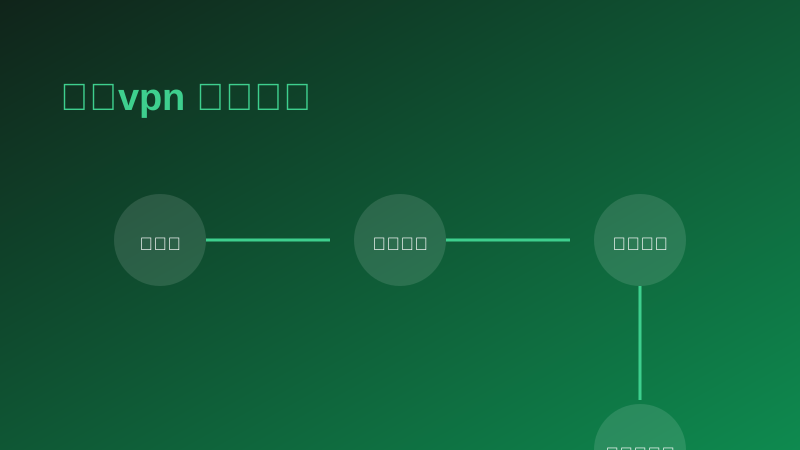
Smart routing answers "which path to take". Green Tea VPN deploys monitoring probes globally, collecting real-time latency, loss and jitter data into a dynamic "network map". When a user connects, the scheduler matches traffic to the optimal current path.
This scheduling is continuous: after connection, monitoring continues, and if the original path degrades, the system switches to a backup without interrupting the connection. Users don't notice the switch, but the latency curve stays smoother.
4. Data and Verification
The lab published comparison data during evening peak (20:00-22:00), sampled from 200 connection sessions across Guangzhou and Shanghai.
| Metric | Direct | Green Tea VPN | Improvement |
|---|---|---|---|
| Avg latency | 162ms | 46ms | ↓ 72% |
| Packet loss | 3.8% | 0.4% | ↓ 89% |
| Usable bandwidth | 18 Mbps | 76 Mbps | ↑ 322% |
| Component | Function | Key Point |
|---|---|---|
| Multi-link aggregation | Bandwidth stacking + redundancy | Up to 4 links |
| Smart routing | Dynamic path selection | Global monitoring probes |
| Protocol optimization | Lower handshake overhead | Adaptive congestion control |
| Encrypted tunnel | Data security | AES-256 end-to-end |
"Now I understand why it's fast — multi-link is impressive."
"Stable 40ms even at peak, smart routing works."
"Large downloads clearly stack up in speed."
"Almost never drops, aggregation redundancy is solid."
5. Conclusion
Acceleration is not about creating bandwidth from nothing, but putting data on better paths and stacking multi-path capacity. Green Tea VPN's multi-link aggregation and smart routing are exactly that idea in engineering. If you now understand "why it's fast", download and see if the numbers hold up.